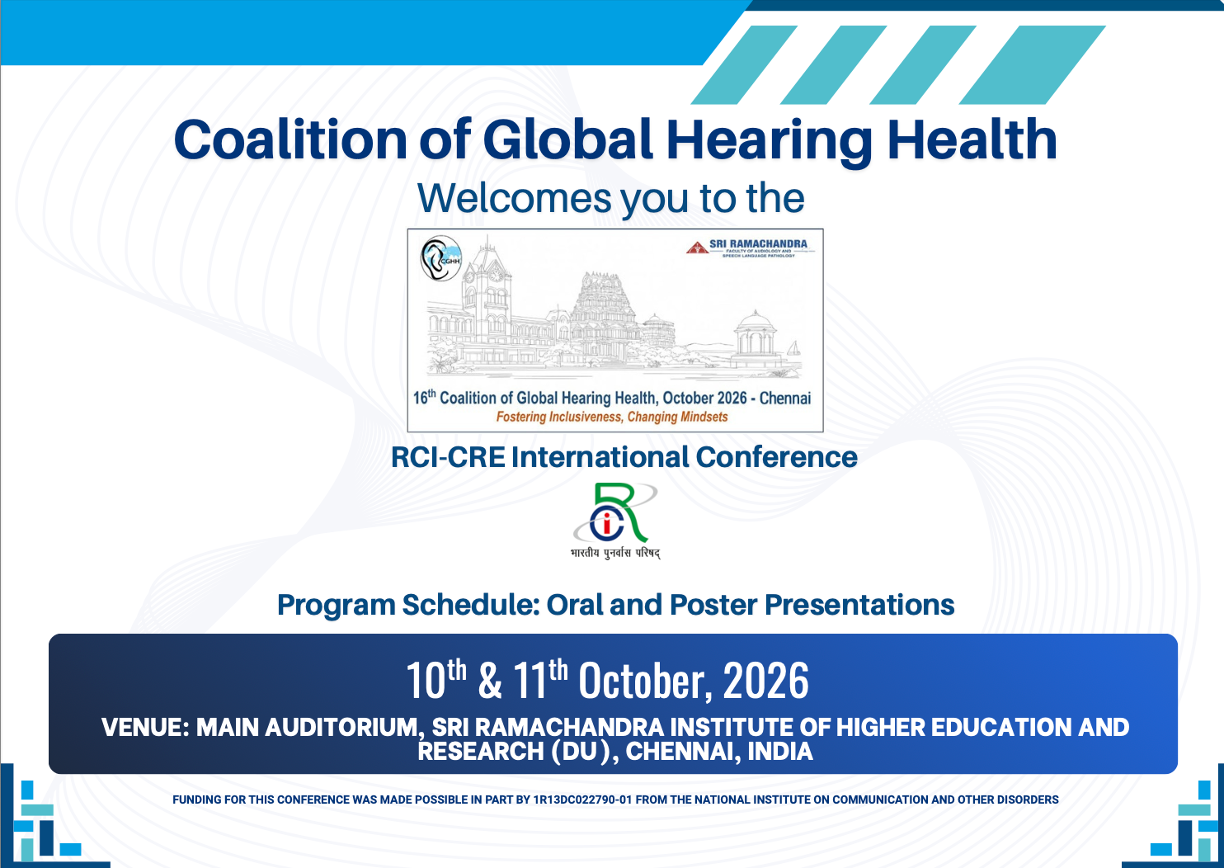
Saturday 10th October 2026

12:00 – 1:00 PM

Hall 3: Poster presentations


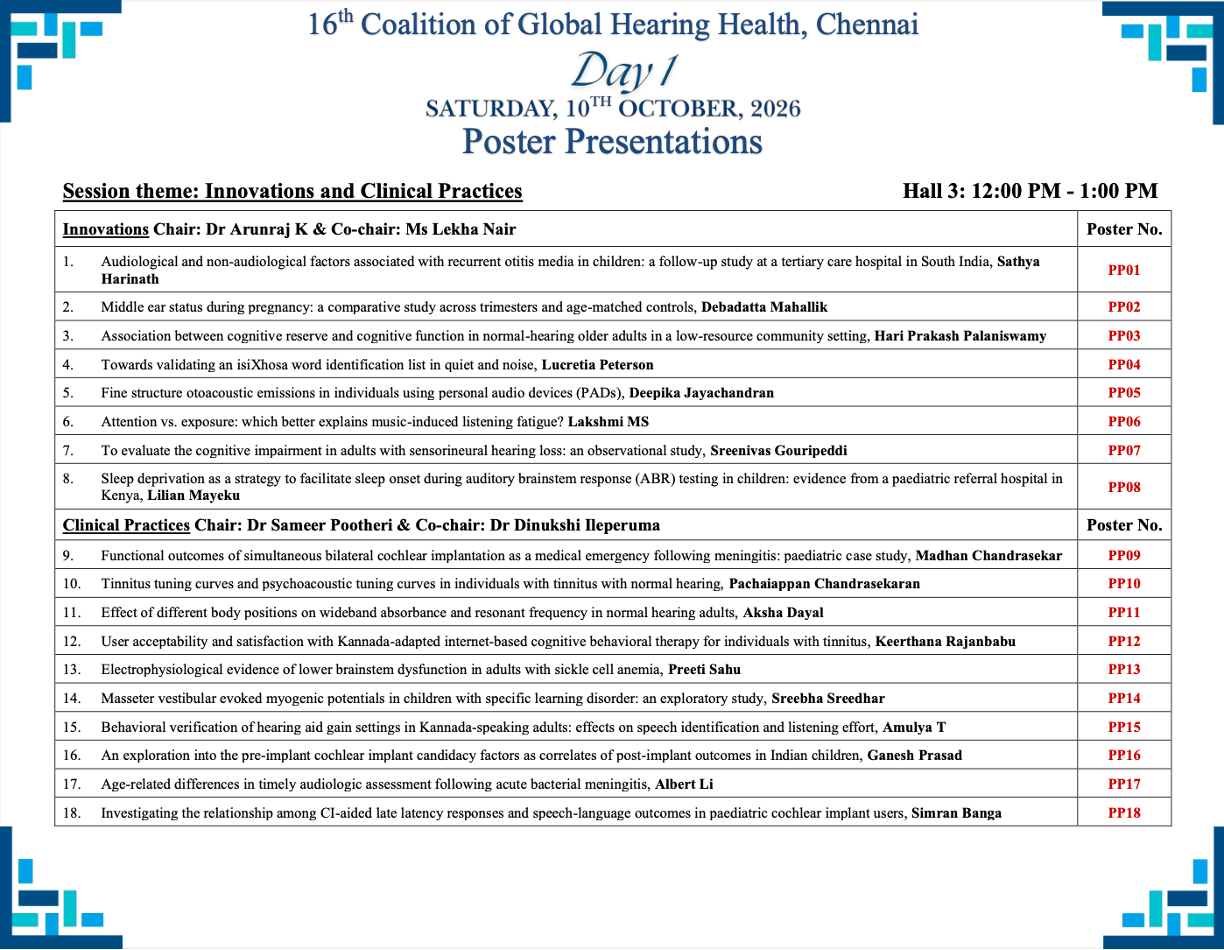
Session theme: Innovations and clinical practices (19 slots)


Innovations


1.         Audiological and non-audiological factors associated with recurrent otitis media in children: a follow-up study at a tertiary care hospital in South India, Sathya Harinath

PP01

2.         Middle ear status during pregnancy: a comparative study across trimesters and age-matched controls, Debadatta Mahallik

PP02

3.         Bilateral microtia, cleft palate and severe conductive hearing loss in a 14-month-old identified at a rural outreach camp in Zimbabwe, Gladys Muchemwa

PP03

4.         Association between cognitive reserve and cognitive function in normal-hearing older adults in a low-resource community setting, Hari Prakash Palaniswamy

PP04

5.         Towards validating an isiXhosa word identification list in quiet and noise, Lucretia Peterson

PP05

6.         Fine structure otoacoustic emissions in individuals using personal audio devices (PADs), Deepika Jayachandran

PP06

7.         Attention vs. exposure: which better explains music induced listening fatigue?, Lakshmi MS

PP07

8.         To evaluate the cognitive impairment in adults with sensorineural hearing loss: an observational study, Sreenivas Gouripeddi

PP08

9.         Sleep deprivation as a strategy to facilitate sleep onset during auditory brainstem response (ABR) testing in children: evidence from a paediatric referral hospital in Kenya, Lilian Mayeku

PP09


Clinical practices


10.      Functional outcomes of simultaneous bilateral cochlear implantation as a medical emergency following meningitis: paediatric case study, Madhan Chandrasekar

PP10

11.      Tinnitus tuning curves and psychoacoustic tuning curves in individuals with tinnitus with normal hearing, Pachaiappan Chandrasekaran

PP11

12.      Effect of different body positions on wideband absorbance and resonant frequency in normal hearing adults, Aksha Dayal

PP12

13.      User acceptability and satisfaction with Kannada-adapted internet-based cognitive behavioral therapy for individuals with tinnitus, Keerthana Rajanbabu

PP13

14.      Electrophysiological evidence of lower brainstem dysfunction in adults with sickle cell anemia, Preeti Sahu

PP14

15.      Masseter vestibular evoked myogenic potentials in children with specific learning disorder: an exploratory study, Sreebha Sreedhar

PP15

16.      Behavioral verification of hearing aid gain settings in Kannada-speaking adults: effects on speech identification and listening effort, Amulya T

PP16

17.      An exploration into the pre-implant cochlear implant candidacy factors as correlates of post-implant outcomes in Indian children, Ganesh Prasad

PP17

18.      Age-related differences in timely audiologic assessment following acute bacterial meningitis, Albert Li

PP18

19.      Investigating the relationship among CI-aided late latency responses and speech-language outcomes in paediatric cochlear implant users, Simran Banga

PP19

2:45 – 4:15 PM

Hall 3: Poster presentations


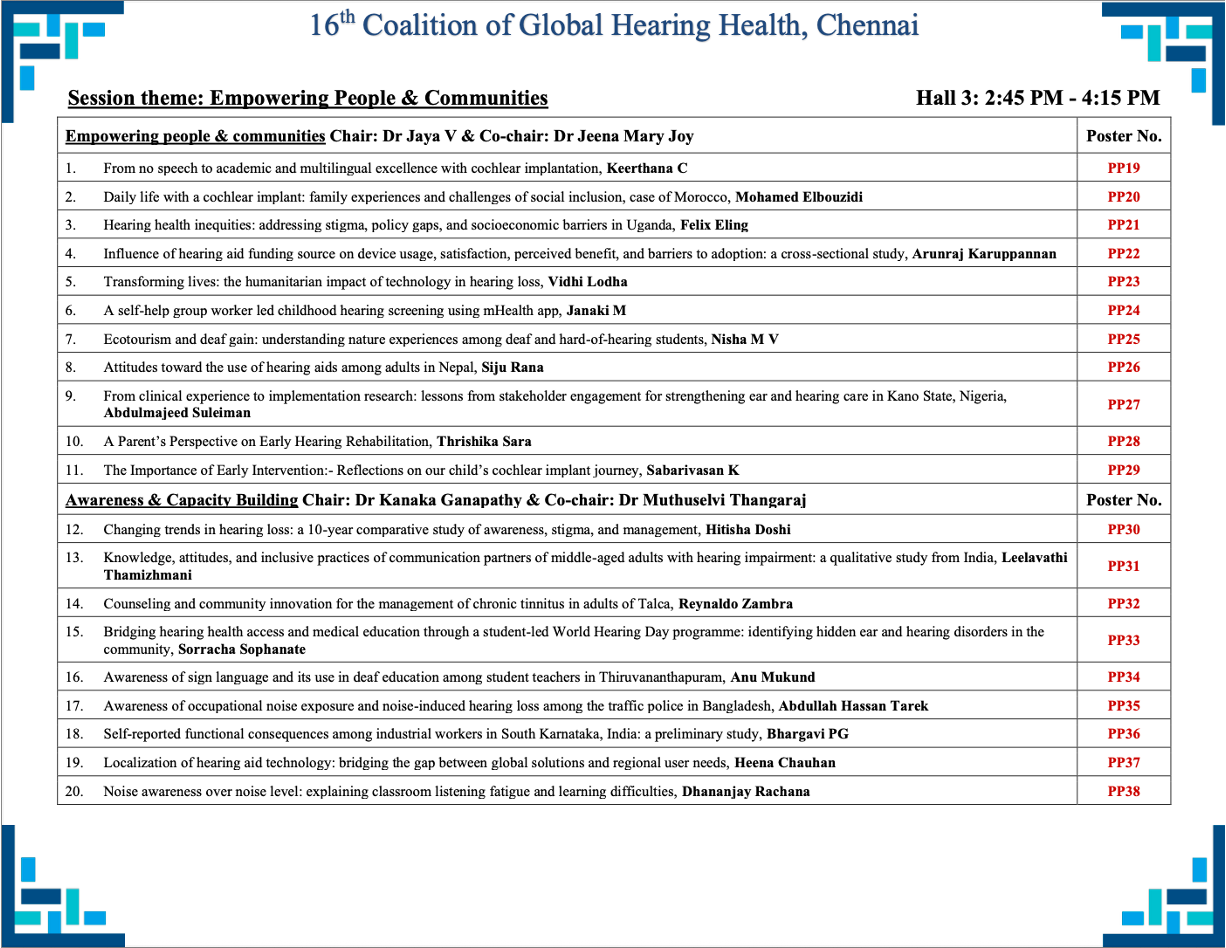
Session theme: Empowering people & communities (18 slots)


Empowering people & communities


1.         From no speech to academic and multilingual excellence with cochlear implantation, Keerthana C

PP20

2.         Daily life with a cochlear implant: family experiences and challenges of social inclusion, case of Morocco, Mohamed Elbouzidi

PP21

3.         Hearing health inequities: addressing stigma, policy gaps, and socioeconomic barriers in Uganda, Felix Eling

PP22

4.         Influence of hearing aid funding source on device usage, satisfaction, perceived benefit, and barriers to adoption: a cross-sectional study, Arunraj Karuppannan

PP23

5.         Transforming lives: the humanitarian impact of technology in hearing loss, Vidhi Lodha

PP24

6.         A self-help group worker led childhood hearing screening using mHealth app, Janaki M

PP25

7.         Ecotourism and deaf gain: understanding nature experiences among deaf and hard-of-hearing students, Nisha M V

PP26

8.         Attitudes toward the use of hearing aids among adults in Nepal, Siju Rana

PP27

9.         From clinical experience to implementation research: lessons from stakeholder engagement for strengthening ear and hearing care in Kano State, Nigeria, Abdulmajeed Suleiman

PP28

Awareness & capacity building


10.      Changing trends in hearing loss: a 10-year comparative study of awareness, stigma and management, Hitisha Doshi

PP29

11.      Knowledge, attitudes, and inclusive practices of communication partners of middle-aged adults with hearing impairment: a qualitative study from India, Leelavathi Thamizhmani

PP30

12.      Counseling and community innovation for the management of chronic tinnitus in adults of Talca, Reynaldo Zambra

PP31

13.      Bridging hearing health access and medical education through a student-led World Hearing Day programme: identifying hidden ear and hearing disorders in the community, Sorracha Sophanate

PP32

14.      Awareness of sign language and its use in deaf education among student teachers in Thiruvananthapuram, Anu Mukund

PP33

15.      Awareness of occupational noise exposure and noise-induced hearing loss among the traffic police in Bangladesh, Abdullah Hassan Tarek

PP34

16.      Self-reported functional consequences among industrial workers in South Karnataka, India: a preliminary study, Bhargavi PG

PP35

17.      Localization of hearing aid technology: bridging the gap between global solutions and regional user needs, Heena Chauhan

PP36

18.      Noise awareness over noise level: explaining classroom listening fatigue and learning difficulties, Dhananjay Rachana

PP37

Sunday 11th October 2026

11:00 AM – 1:15PM

Hall 3: Poster presentations


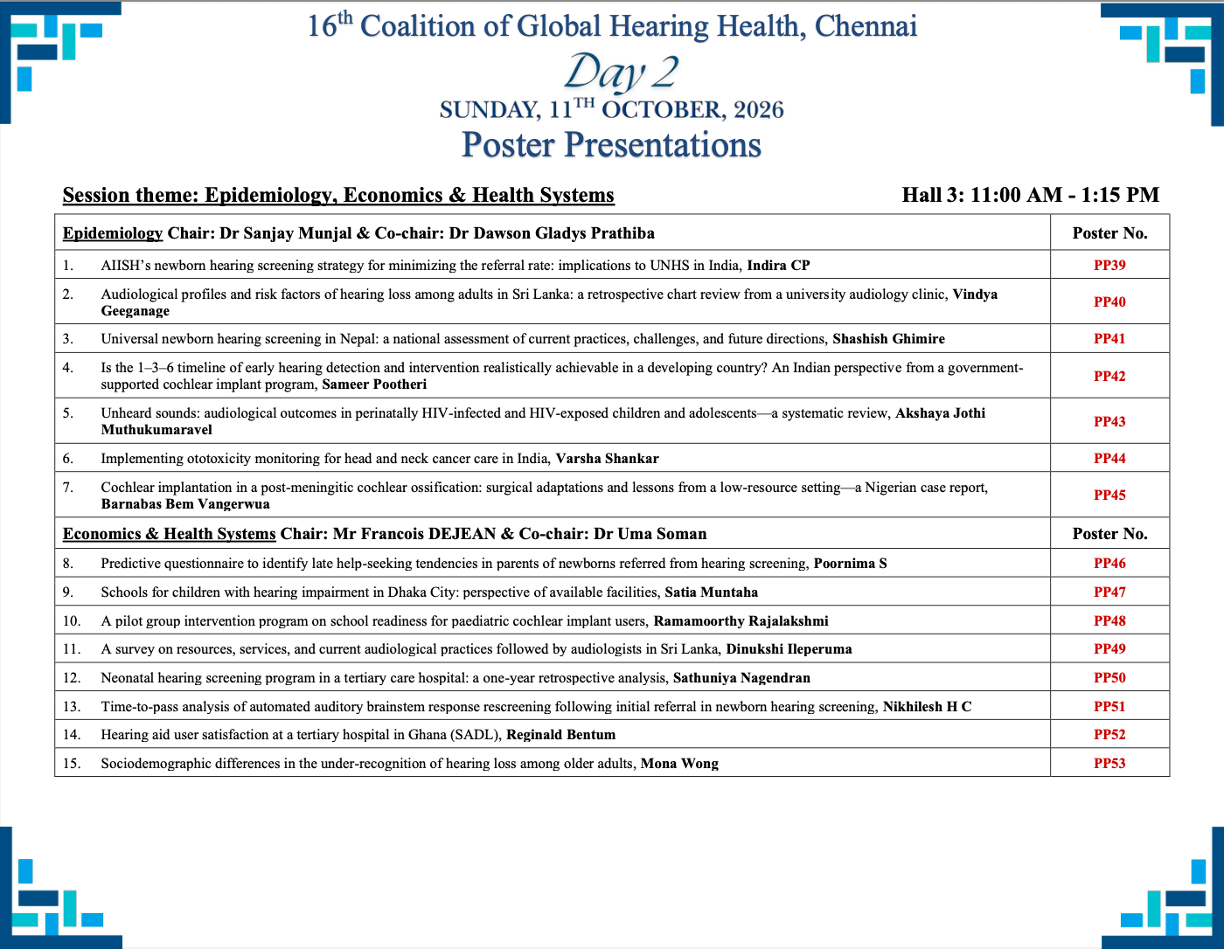
Session theme: Epidemiology, economics & health systems (18 slots)


Epidemiology


1.         AIISH’s newborn hearing screening strategy for minimizing the referral rate: implications to UNHS in India, Indira CP

PP38

2.         Audiological profiles and risk factors of hearing loss among adults in Sri Lanka: a retrospective chart review from a university audiology clinic, Vindya Geeganage

PP39

3.         Universal newborn hearing screening in Nepal: a national assessment of current practices, challenges and future directions, Shashish Ghimire

PP40

4.         Is the 1–3–6 timeline of early hearing detection and intervention realistically achievable in a developing country? An Indian perspective from a government-supported cochlear implant program, Sameer Pootheri

PP41

5.         Unheard sounds: audiological outcomes in perinatally HIV-infected and HIV-exposed children and adolescents – a systematic review, Akshaya Jothi Muthukumaravel

PP42

6.         Implementing ototoxicity monitoring for head and neck cancer care in India, Varsha Shankar

PP43

7.         Cochlear implantation in a post-meningitic cochlear ossification: surgical adaptations and lessons from a low-resource setting – a Nigerian case report, Barnabas Bem Vangerwua

PP44

8.         Prevalence of hyperacusis among hearing impaired with hearing loss and tinnitus in Nepal, Rejina Adhikari

PP45

9.         Prevalence of hyperacusis among general population in Nepal, Anjali Shriwastav

PP46

Economics & health systems


10.      Predictive questionnaire to identify late help seeking tendencies in parents of newborns referred from hearing screening, Poornima S

PP47

11.      Schools for children with hearing impairment in Dhaka City: perspective of available facilities, Satia Muntaha

PP48

12.      A pilot group intervention program on school readiness for paediatric cochlear implant users, Ramamoorthy Rajalakshmi

PP49

13.      A survey on resources, services, and current audiological practices followed by audiologists in Sri Lanka, Dinukshi Ileperuma

PP50

14.      Neonatal hearing screening program in a tertiary care hospital: a one year retrospective analysis, Sathuniya Nagendran

PP51

15.      Time-to-pass analysis of automated auditory brainstem response rescreening following initial referral in newborn hearing screening, Nikhilesh H C

PP52

16.      Hyperacusis in tinnitus patients without hearing loss: findings from a preliminary exploratory study, Anjali Shriwastav

PP53

17.      Hearing aid user satisfaction at a tertiary hospital in Ghana (SADL), Reginald Bentum

PP54

18.      Sociodemographic differences in the under-recognition of hearing loss among older adults, Mona Wong

PP55

2:15 – 3:00PM

Hall 3: Poster presentations


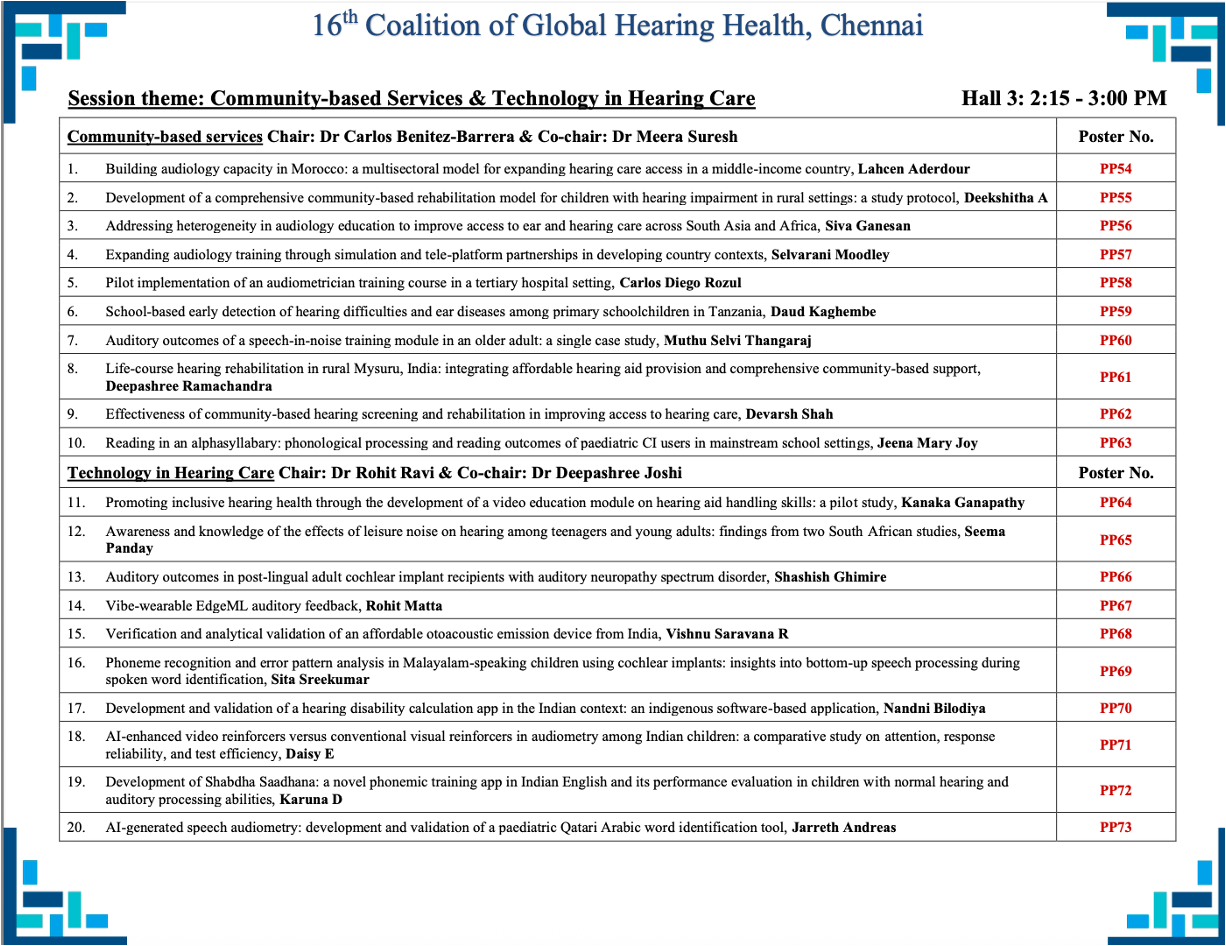
Session theme: Community based services & technology in hearing care (20 slots)


Community based services


1.         Building audiology capacity in Morocco: a multisectoral model for expanding hearing care access in a middle-income country, Lahcen Aderdour

PP56

2.         Development of a comprehensive community-based rehabilitation model for children with hearing impairment in rural settings: a study protocol, Deekshitha A S

PP57

3.         Addressing heterogeneity in audiology education to improve access to ear and hearing care across South Asia and Africa, Siva Ganesan

PP58

4.         Expanding audiology training through simulation and tele-platform partnerships in developing country contexts, Selvarani Moodley

PP59

5.         Pilot implementation of an audiometrician training course in a tertiary hospital setting, Carlos Diego Rozul

PP60

6.         School-based early detection of hearing difficulties and ear diseases among primary schoolchildren in Tanzania, Daud Kaghembe

PP61

7.         Auditory outcomes of a speech-in-noise training module in an older adult: a single case study, Muthu selvi Thangaraj

PP62

8.         Life-course hearing rehabilitation in rural Mysuru, India: integrating affordable hearing aid provision and comprehensive community-based support, Deepashree Ramachandra

PP63

9.         Effectiveness of community-based hearing screening and rehabilitation in improving access to hearing care, Devarsh Shah

PP64

10.      Reading in an alphasyllabary: phonological processing and reading outcomes of paediatric CI users in mainstream school settings, Jeena Mary Joy

PP65

Technology in hearing care


11.      Promoting inclusive hearing health through the development of a video education module on hearing aid handling skills: a pilot study, Kanaka Ganapathy

PP66


12.      Awareness and knowledge of the effects of leisure noise on hearing among teenagers and young adults: findings from two South African studies, Seema Panday

PP67

13.      Auditory outcomes in post-lingual adult cochlear implant recipients with auditory neuropathy spectrum disorder, Shashish Ghimire

PP68

14.      Vibe-wearable EdgeML auditory feedback, Rohit Matta

PP69

15.      Verification and analytical validation of an affordable otoacoustic emission device from India, Vishnu Saravana R

PP70

16.      Phoneme recognition and error pattern analysis in Malayalam-speaking children using cochlear implants: insights into bottom-up speech processing during spoken word identification, Sita Sreekumar

PP71

17.      Development and validation of hearing disability calculation app in Indian context: an indigenous software based application, Nandni Bilodiya

PP72

18.      AI-enhanced video reinforcers versus conventional visual reinforcers in audiometry among Indian children: a comparative study on attention, response reliability and test efficiency, Daisy E

PP73

19.      Development of Shabdha Saadhana: a novel phonemic training app in Indian English and its performance evaluation in children with normal hearing and auditory processing abilities, Karuna D

PP74

20.      AI-generated speech audiometry: development and validation of a paediatric Qatari Arabic word identification tool, Jarreth Andreas

PP75

“Funding for this conference was made possible in part by 1R13DC022790-01 from National Institute of Communication and Other Disorders. The views expressed in written conference materials or publications and by speakers and moderators do not necessarily reflect the official policies of the Department of Health and Human Services; nor does mention of trade names, commercial practices, or organizations imply endorsement by the U.S. Government.”

Contact the community manager George Dempster by e-mail gd@e2.co.za or mobile +44 7895 95 1871