|
Saturday 10th October 2026 |
||||
|
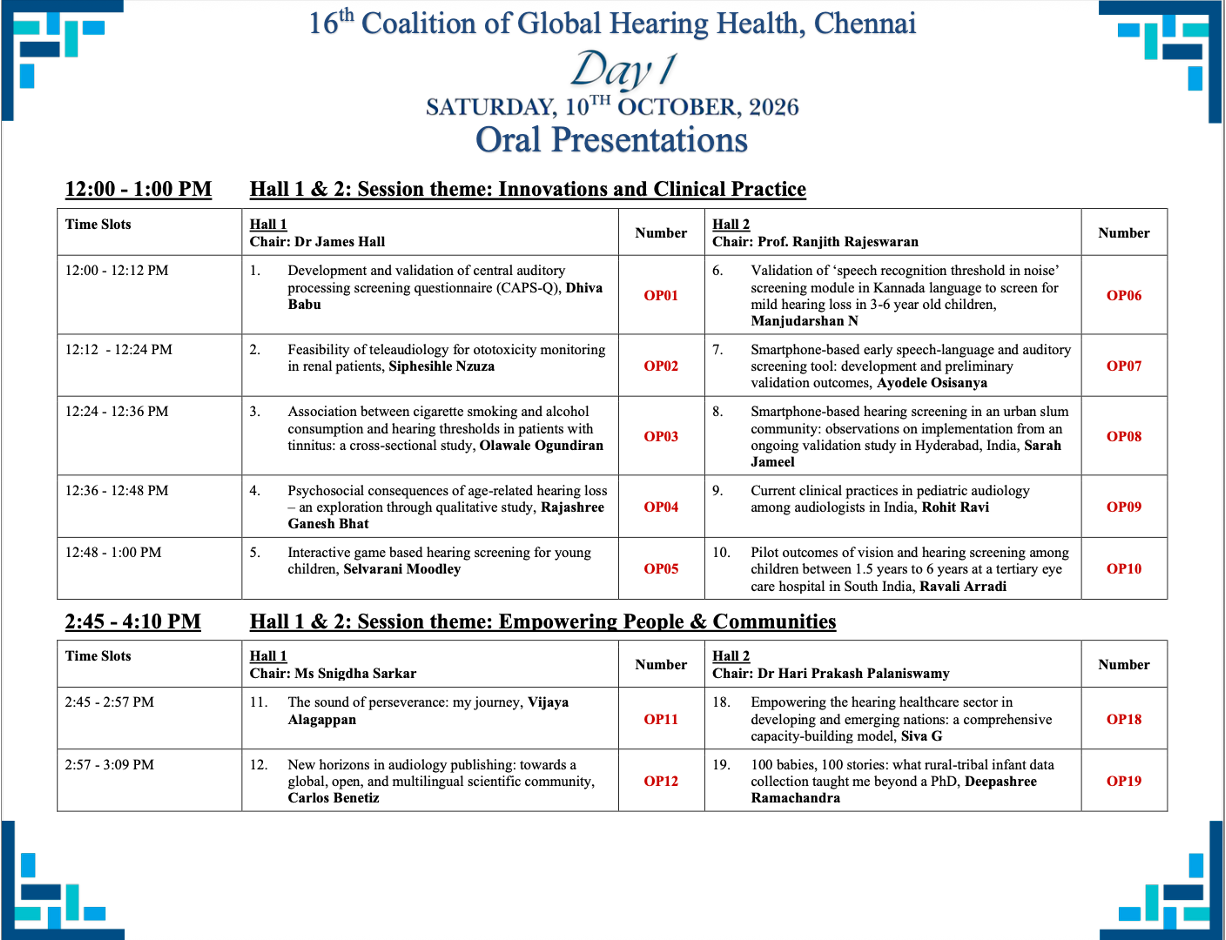
12:00 – 1:00 PM |
Hall 1 & 2: Oral presentations Session theme: Innovations and clinical practice (10 slots) |
|||
|
Time Slots |
Hall 1 |
Number |
Hall 2 |
Number |
|
12:00 – 12:12 PM |
1. Development and validation of central auditory processing screening questionnaire (CAPS-Q), Dhiva Babu |
OP01 |
6. Validation of ‘speech recognition threshold in noise’ screening module in Kannada language to screen for mild hearing loss in 3-6 year old children, Manjudarshan N |
OP06 |
|
12:12 – 12:24 PM |
2. Feasibility of teleaudiology for ototoxicity monitoring in renal patients, Siphesihle Nzuza |
OP02 |
7. Smartphone-based early speech-language and auditory screening tool: development and preliminary validation outcomes, Ayodele Osisanya |
OP07 |
|
12:24 – 12:36 PM |
3. Association between cigarette smoking and alcohol consumption and hearing thresholds in patients with tinnitus: a cross-sectional study, Olawale Ogundiran |
OP03 |
8. Smartphone-based hearing screening in an urban slum community: observations on implementation from an ongoing validation study in Hyderabad, India, Sarah Jameel |
OP08 |
|
12:36 – 12:48 PM |
4. Psychosocial consequences of age-related hearing loss – an exploration through qualitative study, Rajashree Ganesh Bhat |
OP04 |
9. Current clinical practices in pediatric audiology among audiologists in India, Rohit Ravi |
OP09 |
|
12:48 – 1:00 PM |
5. Interactive game based hearing screening for young children, Selvarani Moodley |
OP05 |
10. Pilot outcomes of vision and hearing screening among children between 1.5 years to 6 years at a tertiary eye care hospital in South India, Ravali Arradi |
OP10 |
|
2:45 – 4:10 PM |
Hall 1 & 2: Oral presentations Session theme: Empowering people & communities (14 slots) |
|||
|
Time Slots |
Hall 1 |
Number |
Hall 2 |
Number |
|
2:45 – 2:57 PM |
11. The sound of perseverance: my journey, Vijaya Alagappan |
OP11 |
18. Empowering the hearing healthcare sector in developing and emerging nations: a comprehensive capacity-building model, Siva Ganesan |
OP18 |
|
2:57 – 3:09 PM |
12. New horizons in audiology publishing: towards a global, open, and multilingual scientific community, Carlos Benetiz |
OP12 |
19. 100 babies, 100 stories: what rural-tribal infant data collection taught me beyond a PhD, Deepashree Ramachandra |
OP19 |
|
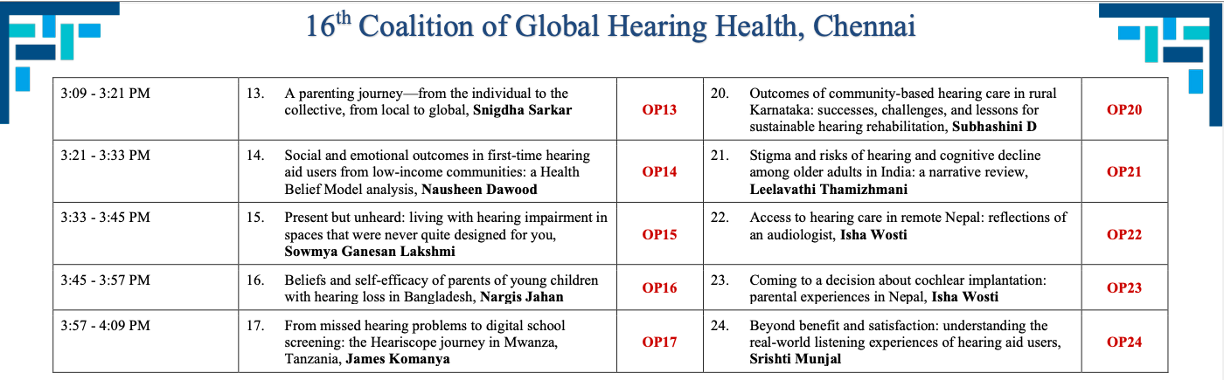
3:09 – 3:21 PM |
13. Outcomes of community based hearing care in rural Karnataka: successes, challenges, and lessons for sustainable hearing rehabilitation, Subhashini D |
OP13 |
20. A parenting journey – from the individual to the collective, from local to global, Snigdha Sarkar |
OP20 |
|
3:21 – 3:33 PM |
14. Social and emotional outcomes in first-time hearing aid users from low-income communities: a Health Belief Model analysis, Nausheen Dawood |
OP14 |
21. Stigma and risks of hearing and cognitive decline among older adults in India: a narrative review, Leelavathi Thamizhmani |
OP21 |
|
3:33 – 3:45 PM |
15. Present but unheard: living with hearing impairment in spaces that were never quite designed for you, Sowmya Ganesan Lakshmi |
OP15 |
22. Access to hearing care in remote Nepal: reflections of an audiologist, Isha Wosti |
OP22 |
|
3:45 – 3:57 PM |
16. Beliefs and self-efficacy of parents of young children with hearing loss in Bangladesh, Nargis Jahan |
OP16 |
23. Coming to a decision about cochlear implantation: parental experiences in Nepal, Isha Wosti |
OP23 |
|
3:57 – 4:09 PM |
17. From missed hearing problems to digital school screening: the Heariscope journey in Mwanza, Tanzania, James Komanya |
OP17 |
24. Beyond benefit and satisfaction: understanding the real-world listening experiences of hearing aid users, Srishti Munjal |
OP24 |
|
Sunday 11th October 2026 |
||||
|
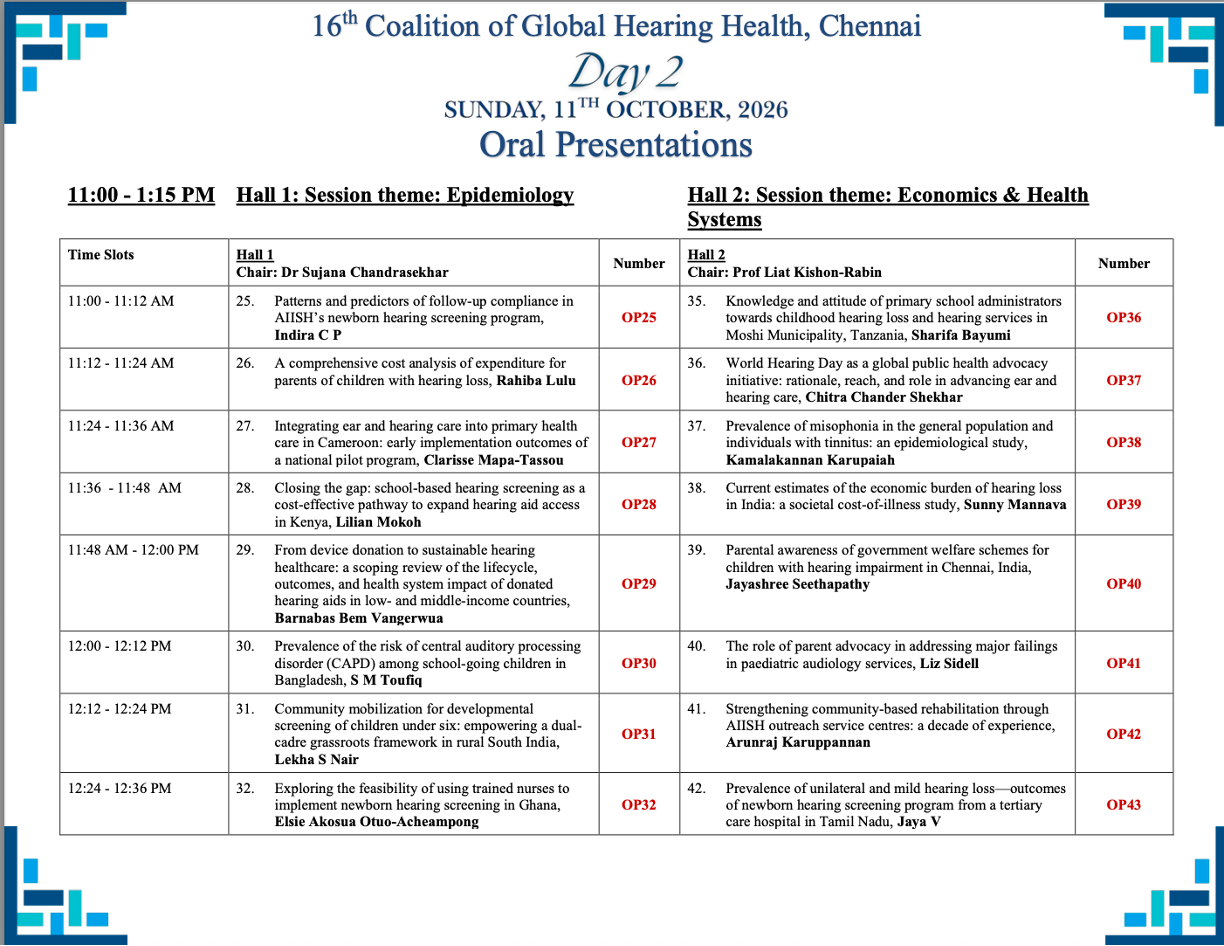
11:00 – 1:15 PM |
Hall 1: Oral presentations Session theme: Epidemiology (10 slots) |
Hall 2: Oral presentations Session theme: Economics & health systems (11 slots) |
||
|
Time Slots |
Hall 1 |
Number |
Hall 2 |
Number |
|
11:00 – 11:12 AM |
25. Patterns and predictors of follow up compliance in AIISH’s newborn hearing screening program, Indira C P |
OP25 |
35. Knowledge and attitude of primary school administrators towards childhood hearing loss and hearing services in Moshi Municipality, Tanzania, Sharifa Bayumi |
OP36 |
|
11:12 – 11:24 AM |
26. A comprehensive cost analysis of expenditure for parents of children with hearing loss, Rahiba Lulu |
OP26 |
36. World Hearing Day as a global public health advocacy initiative: rationale, reach, and role in advancing ear and hearing care, Chitra Chander Shekhar |
OP37 |
|
11:24 – 11:36 AM |
27. Integrating ear and hearing care into primary health care in Cameroon: early implementation outcomes of a national pilot program, Clarisse Mapa-Tassou |
OP27 |
37. Prevalence of misophonia in the general population and individuals with tinnitus: an epidemiological study, Kamalakannan Karupaiah |
OP38 |
|
11:36 – 11:48 AM |
28. Closing the gap: school-based hearing screening as a cost-effective pathway to expand hearing aid access in Kenya, Lilian Mokoh |
OP28 |
38. Current estimates of the economic burden of hearing loss in India: a societal cost-of-illness study, Sunny Mannava |
OP39 |
|
11:48 – 12:00 PM |
29. From device donation to sustainable hearing healthcare: a scoping review of the lifecycle, outcomes, and health system impact of donated hearing aids in low- and middle-income countries, Barnabas Bem Vangerwua |
OP29 |
39. Parental awareness of government welfare schemes for children with hearing impairment in Chennai, India, Jayashree Seethapathy |
OP40 |
|
12:00 – 12:12 PM |
30. Prevalence the risk of central auditory processing disorder (CAPD) among school going children in Bangladesh, S M Toufiq |
OP30 |
40. The role of parent advocacy in addressing major failings in paediatric audiology services, Liz Sidell |
OP41 |
|
12:12 – 12:24 PM |
31. Community mobilization for developmental screening of children under six: empowering a dual-cadre grassroots framework in rural South India, Lekha S Nair |
OP31 |
41. Strengthening community-based rehabilitation through AIISH outreach service centres: a decade of experience, Arunraj Karuppannan |
OP42 |
|
12:24 – 12:36 PM |
32. Exploring the feasibility of using trained nurses to implement newborn hearing screening in Ghana, Elsie Akosua Otuo-Acheampong |
OP32 |
42. Prevalence of unilateral and mild hearing loss – outcomes of newborn hearing screening program from a tertiary care hospital in Tamilnadu, Jaya V |
OP43 |
|
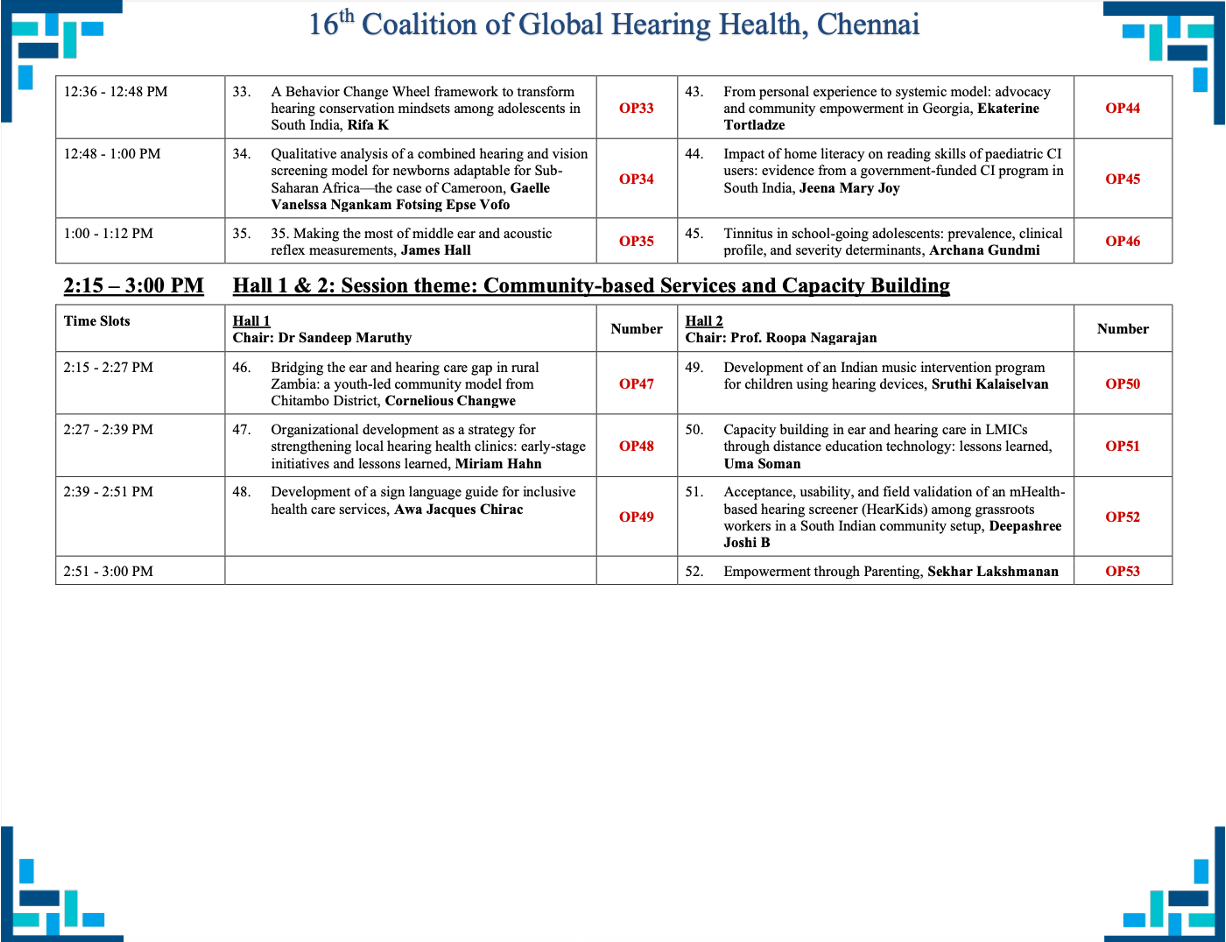
12:36 – 12:48 PM |
33. A Behavior Change Wheel framework to transform hearing conservation mindsets among adolescents in South India, Rifa K |
OP33 |
43. From personal experience to systemic model: advocacy and community empowerment in Georgia, Ekaterine Tortladze |
OP44 |
|
12:48 – 1:00 PM |
34. Qualitative analysis of a combined hearing and vision screening model for newborns adaptable for Sub-Saharan Africa – the case of Cameroon, Gaelle Vanelssa Ngankam Fotsing Epse Vofo |
OP34 |
44. Impact of home literacy on reading skills of paediatric CI users: evidence from a government-funded CI program in South India, Jeena Mary Joy |
OP45 |
|
1:00 – 1:12 PM |
35. 35. Making the most of middle ear and acoustic reflex measurements, James Hall |
OP35 |
45. Tinnitus in school-going adolescents: prevalence, clinical profile, and severity determinants, Archana Gundmi |
OP46 |
|
2:15 – 3:00 PM |
Hall 1 & 2: Oral presentations Session theme: Community-based services and capacity building (6 slots) |
|||
|
Time Slots |
Hall 1 |
Number |
Hall 2 |
Number |
|
2:15 – 2:27 PM |
46. Bridging the ear and hearing care gap in rural Zambia: a youth-led community model from Chitambo District, Cornelious Changwe |
OP47 |
49. Development of an Indian music intervention program for children using hearing devices, Sruthi Kalaiselvan |
OP50 |
|
2:27 – 2:39 PM |
47. Organizational development as a strategy for strengthening local hearing health clinics: early-stage initiatives and lessons learned, Miriam Hahn |
OP48 |
50. Capacity building in ear and hearing care in LMICs through distance education technology: lessons learned, Uma Soman |
OP51 |
|
2:39 – 2:51 PM |
48. Development of a sign language guide for inclusive health care services, Awa Jacques Chirac |
OP49 |
51. Acceptance, usability and field validation of an mHealth based hearing screener (HearKids) among grassroots workers in South Indian community set up, Deepashree Joshi B |
OP52 |
CLICK HERE TO DOWNLOAD THE ORAL SESSIONS AS A PDF
“Funding for this conference was made possible in part by 1R13DC022790-01 from National Institute of Communication and Other Disorders. The views expressed in written conference materials or publications and by speakers and moderators do not necessarily reflect the official policies of the Department of Health and Human Services; nor does mention of trade names, commercial practices, or organizations imply endorsement by the U.S. Government.”